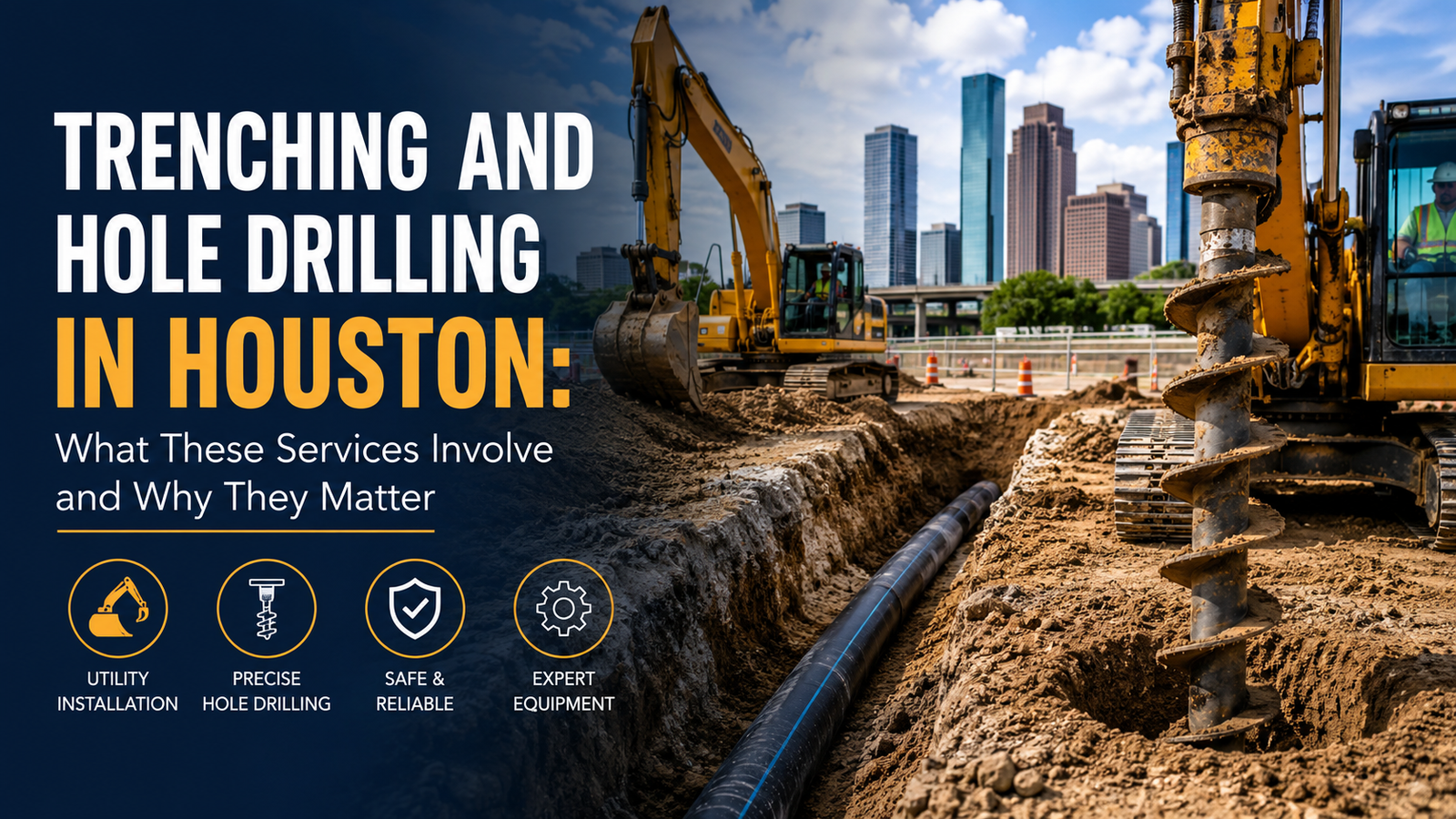
Beneath Houston’s streets, yards, and buildings runs an invisible network of infrastructure water lines, sewer pipes, gas mains, electrical conduits, telecommunications cables, stormwater drains, and the private utility connections that tie every property to these systems. Installing, repairing, or replacing any element of this underground infrastructure requires access to the soil and that access comes through Trenching and Hole Drilling Houston. These services are fundamental to construction across the Houston metro area, and understanding what they involve, how they are performed, and what regulatory requirements apply helps property owners, developers, and project managers plan effectively.
What Is Trenching?
Trenching is the excavation of a narrow, elongated channel in the ground typically for the installation, repair, or replacement of underground utilities, drainage systems, or other linear infrastructure. Trenches are defined primarily by their width, depth, and length relative to each other: they are significantly deeper than they are wide, and significantly longer than they are deep. This geometry distinguishes trenches from broader excavations used for foundations or ponds.
In Houston, trenching serves a remarkable diversity of applications. Residential properties require trenching for new or replacement water service lines, sewer lateral connections, gas lines, irrigation systems, electrical conduit runs, and drainage improvements. Commercial and industrial sites need trenching for much larger utility infrastructure fire suppression systems, process utility lines, stormwater drainage networks, and heavy electrical service. Public infrastructure projects road reconstruction, bayou improvement, drainage district improvements involve extensive trenching throughout Harris County and the City of Houston.
Trenching Methods Used in Houston
Mechanical trenching with excavators and dedicated trenching machines is the standard approach for most utility trenching in Houston. Excavators tracked machines with a hydraulic arm and bucket are extremely versatile for trenching in variable soil conditions, around obstacles, and at varying depths and widths. They are particularly effective in Houston’s clay soils, which hold trench walls reasonably well under most moisture conditions, reducing the need for continuous shoring in shallower trenches.
Dedicated chain trenchers and wheel trenchers specialized machines that cut through soil using a continuous chain or rotating wheel with cutting teeth achieve high production rates on straight trenching runs in consistent, obstacle-free soil. These machines are commonly used for irrigation system installation, electrical conduit runs, and telecommunications cable installation where the trench alignment is straightforward and soil conditions are uniform.
Hydrovac excavation also called vacuum excavation or hydro excavation uses pressurized water to break up soil while a high-powered vacuum simultaneously extracts the resulting slurry. Hydrovac is particularly valuable in the Houston area for utility potholing (exposing specific underground utilities for visual confirmation before construction), for trenching in areas where buried utilities make traditional mechanical excavation risky, and for excavation in sensitive areas where minimizing soil disturbance is a priority. The Texas One Call system (Texas 811) identifies registered utilities, but many older Houston-area utility installations are improperly documented or entirely unregistered. Hydrovac excavation provides a safe “soft dig” method to expose and confirm what is actually present before a production excavator or trencher opens the ground.
Open trenching conventional mechanical excavation creating an accessible open trench is the most common approach when conditions allow. Trenchless alternatives are increasingly used in Houston for specific situations where open trenching is impractical, disruptive, or too costly. Horizontal directional drilling (HDD) installs pipes and conduit beneath roads, parking lots, landscaped areas, and other surfaces without requiring surface excavation along the full bore path. HDD is widely used in Houston for utility installations beneath bayou crossings, under major arterials, and in established neighborhoods where open trenching would damage driveways, landscaping, and pavement. Jack-and-bore systems install steel casings beneath road crossings without open cutting.
OSHA Trench Safety Requirements in Houston
Trenching is one of the most hazardous construction activities, and OSHA’s standards specifically address trench safety under 29 CFR 1926.651 and 1926.652. These standards have direct application to trenching work across Houston and Harris County. The key requirements include: positive identification of all underground utilities before excavation begins; a competent person on site who can identify existing and predictive hazards in the surroundings, with the authority to take prompt corrective action; and cave-in protection for any trench deeper than 5 feet.
Cave-in protection can be achieved through sloping the trench walls at safe angles (which requires additional horizontal space and generates more spoil material), shoring the trench walls with hydraulic or timber shoring systems, or using a trench box or shield that provides a protected work space inside the trench. Houston’s clay soils generally provide better trench wall stability than sandy or gravelly soils, but clay that has been softened by water infiltration can be unpredictable. Following OSHA cave-in protection requirements regardless of apparent soil stability is standard professional practice.
Texas law requires notification through Texas 811 (Dig Safe) at least two business days before any excavation begins. This notification triggers the locate and marking of registered underground utilities in the excavation area. 811 locates are a legal requirement and a critical safety step but they identify only registered utility lines from member utilities. Private utility lines, abandoned infrastructure, and improperly documented lines do not appear in the 811 system. For this reason, hydrovac potholing is standard practice in established Houston corridors before production trenching begins in areas with utility congestion.
Hole Drilling in Houston
Hole drilling creating circular vertical or angled openings in soil, concrete, or rock serves several distinct purposes in Houston construction and infrastructure work. Post holes for fencing, signage, and structural supports are the most common residential application. Sign and light pole foundations require holes of specific diameter and depth to provide adequate structural anchorage. Earth anchors for retaining wall tiebacks, utility pole bases, and foundation piers are additional applications.
Auger drilling uses a rotating helical screw the auger to penetrate the ground and extract soil material as the hole is advanced. Track-mounted hydraulic auger units can drill holes from a few inches to several feet in diameter and to significant depths. Helical pile installation a foundation system that screws large steel helical anchors into the ground uses specialized drilling rigs to install pier foundations for structures, retaining walls, and elevated decks without requiring open excavation.
Rock drilling and soil boring for geotechnical investigation testing the subsurface soil and rock conditions before design and construction begin is performed by geotechnical drilling contractors throughout the Houston area. Soil borings provide the data that structural engineers use to design foundations, and geotechnical investigation is required for most significant construction projects in the Houston area. The region’s variable soil conditions ranging from soft clay in low-lying areas to stiffer soils in elevated areas make geotechnical investigation particularly important for foundation design.
Houston-Specific Context for Trenching and Hole Drilling
Houston’s underground utility environment is among the most complex in the country. Decades of urban development, utility system expansions, multiple phases of private and public infrastructure construction, and imperfect documentation of older utility installations have created a subsurface landscape that contractors must navigate with great care. Established neighborhoods in Houston the Heights, Montrose, Third Ward, Garden Oaks, and many others have underground infrastructure that spans generations of installation. 811 locate marks provide a starting point, but visual confirmation through potholing before full production trenching is standard professional practice in these areas.
Houston’s clay soils create distinctive trenching conditions. The stiff, high-plasticity clay that underlies much of the city holds trench walls reasonably well in dry conditions but becomes much more problematic when saturated. Houston’s rainfall patterns including intense storms that can deliver several inches of rain in a few hours mean that trench conditions can change rapidly. Experienced Houston trenching contractors plan water management as part of every trench project, including dewatering provisions when trenches reach below the water table or when rainfall could saturate the trench zone.
Frequently Asked Questions About Trenching and Hole Drilling in Houston
Is Texas 811 notification required before all trenching? Yes. Texas law requires that any person planning to excavate must notify Texas 811 at least two business days before digging begins. This applies to all excavation, including private property trenching. The notification triggers utility locate marking by registered member utilities.
What is hydrovac excavation and when is it used in Houston? Hydrovac excavation uses pressurized water to break soil and a vacuum to extract the slurry, providing a “soft dig” method that can expose buried utilities without striking them with hard metal excavation tools. It is used in Houston for utility potholing (confirming utility location before production trenching), for excavation near existing utilities, and in sensitive areas where mechanical excavation could cause damage.
What is the minimum trench depth for a residential water line in Houston? Minimum burial depths for utilities are set by applicable codes and utility provider standards. Water supply lines are typically installed 18 to 24 inches below grade in the Houston area. Sewer laterals, gas lines, and electrical conduit have different depth requirements. Your contractor and the applicable utility provider can specify the required burial depth for your specific installation.